
Institutional success requires more than expertise.
That statement is more uncomfortable than controversial. Expertise alone cannot guarantee success; execution, resources, coordination, and accountability also matter.
Yet institutions can recognize credentials and individual excellence more readily than they recognize responsibility for the complete outcome. Credentials establish qualifications. They do not, by themselves, establish someone’s contribution to institutional success. Accepting that distinction means applying it to roles, recognition, and participation.
This is a barrier to dependable AI in medicine: expertise may be present in every function while the dependencies between those functions remain unverified, under-resourced, or unowned.
A technical assumption goes unchecked. A clinical requirement is lost in translation. A consequential decision moves forward without sufficient evidence. Each function may have completed its assigned work while the institution remains exposed.
Success requires extreme attention to multiple layers of detail, anticipation of how they interact, verification that requirements are met, and ownership of the complete enterprise outcome.
That was the organizing challenge behind the Trustworthy Technology & Innovation Consortium’s High-Reliability Agentic AI track at AIMed26, held November 11, 2026, in Orlando.
Celebrating TTIC’s third anniversary, we brought medicine, technology, law, professional sports, and capital into one conversation:
What must be true before an institution can responsibly depend on consequential AI?

From individual expertise to institutional outcomes
Clinical expertise is indispensable. So are technical, legal, operational, and financial judgment. Their contributions must connect while their distinct authorities remain clear.
An AI system may perform well technically yet lack a viable clinical workflow. A promising investment may lack the institutional capacity to implement it. A governance claim may lack the evidence needed to substantiate it.
Assembling experts does not automatically establish who owns these dependencies, resolves conflicting requirements, authorizes action, or verifies the result. Accountability is the missing link: someone must answer for the complete outcome, not only for a piece of it.
The economic goal is ownership and delivery of complete enterprise outcomes. Expertise contributes to that goal when it helps an institution deliver dependable care, protect clinical judgment, manage exposure, and sustain value.
Our track examined what must connect for that to happen.
Why professional sports and capital belonged

TTIC’s earlier programming emphasized the technical, legal, and cybersecurity dimensions of trustworthy technology. At AIMed26, we broadened the discussion to include professional sports, venture capital, and capital stewardship.
Our experience around NBA Summer League helped shape that direction. Professional sports offers a demanding setting for examining decisions involving health, performance, safety, financial exposure, and organizational accountability.
Capital brings another necessary perspective. Healthcare AI must attract resources, survive implementation, and produce sufficient value to remain dependable over time. Fundability, implementation readiness, and durable value require related but distinct judgments.
Bringing these perspectives together made the institutional requirements more visible. Each discipline held part of the answer; the enterprise outcome depended on how those answers worked together.
What the faculty contributed
The program moved from institutional architecture through clinical and legal authority, high-performance operations, capital formation, capital stewardship, and evidence and assurance.
Apurv Gupta, MD, MPH, Chair, Clinical Excellence, TTIC; Arthur Douville, MD, CMO, Medigram, and Co-Chair, Clinical Integration, TTIC; and Noel Gillespie, Chair, MedTech Practice, Buchalter, and Chair, Law, TTIC, grounded the clinical and legal discussion in independent clinical judgment, decision authority, patient safety, and accountability. Their session examined what institutions must establish when AI enters care.
Brian Yam, COO, Somnology, and Chair, Pro Sports Workstream, TTIC, and Matt Brooker, AVP, NBA, brought professional sports’ operational discipline into focus through the NBA risk-and-opportunity fireside. Their discussion connected people, performance, data, and reputation in a high-performance environment.
Dennis M. Zaslavsky, Senior Managing Director, Clearstead Advisors, LLC, and Lisa Yu, General Partner, 99VC, examined the transition from research to enterprise capability. Their perspectives connected innovation with entrepreneurial capital, emerging technology, markets, and the execution required for adoption. Lisa brought complementary venture capital and go-to-market perspectives to the discussion.
Mariia Eroshin, JD, MBA, CFA, CPA, CFP®, Esq., Partner, Certuity, brought the capital steward’s view: what makes capability durable, how governance supports long-term value, and why securing funding is only one part of institutional success.
Ed Gaudet, CEO, Censinet, and Chair, Compliance, TTIC, sharpened the evidence and assurance discussion around a direct challenge: “You Say It’s Governed. Prove It.” Institutions need evidence sufficient to support their claims about governance, risk, and responsible operation.
Together, these contributions demonstrated why dependable AI requires complementary forms of authority and judgment, connected around an accountable outcome.
Anticipation, verification, and outcome ownership
Three operating disciplines ran through the track.
Anticipation means understanding dependencies before they become failures. What must another function know? Which assumption could invalidate the plan? What happens when a critical condition changes?
Verification means establishing whether requirements have actually been met. A policy, assertion, or completed task is not automatically sufficient evidence of readiness.
Outcome ownership means following the work through to its institutional result. Responsibility must remain explicit when decisions cross clinical, technical, legal, operational, or financial boundaries.
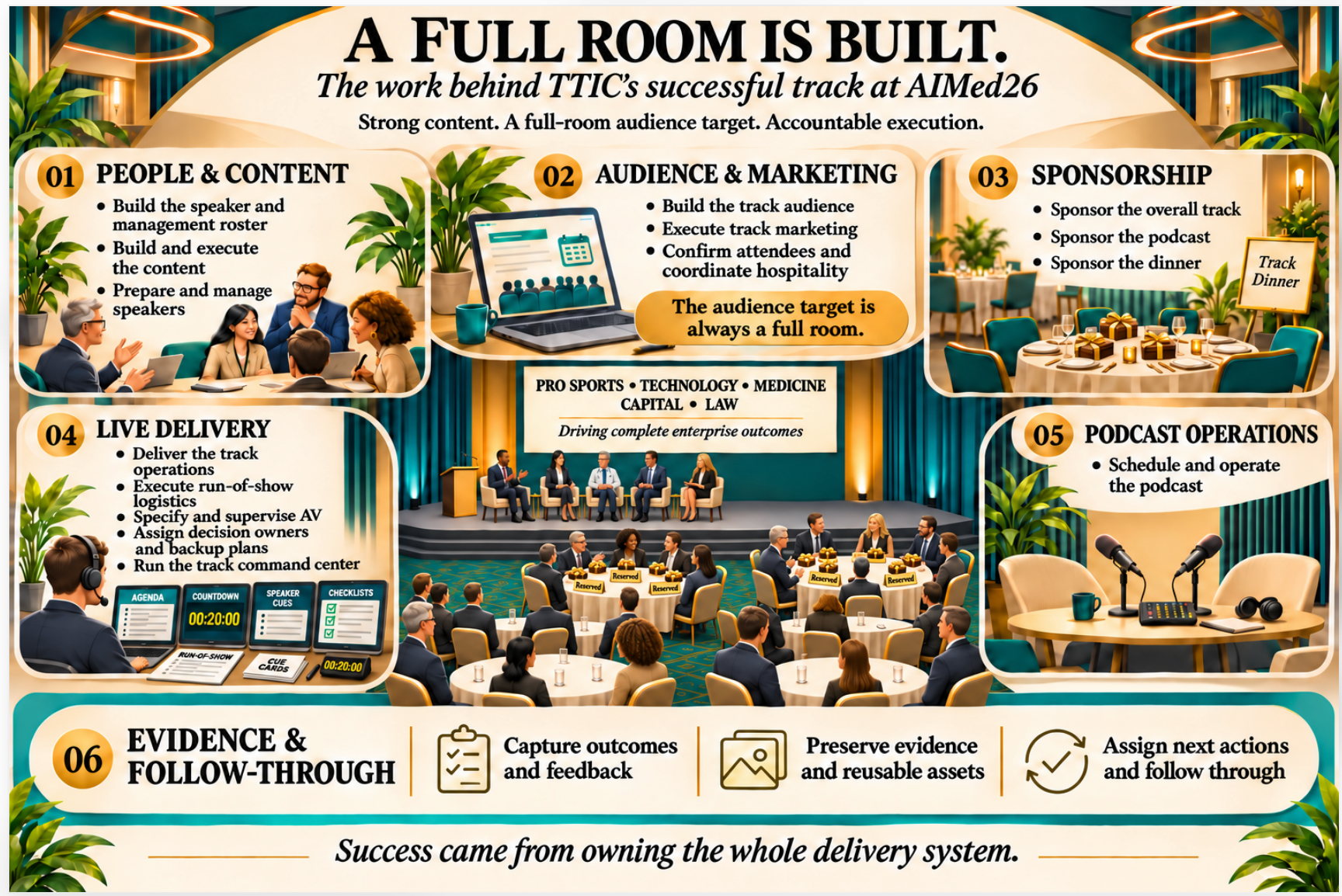
These disciplines also shaped delivery of the track. A full room was always the audience target. Reaching that audience and delivering value required substantive content, preparation, outreach, clear responsibilities, and follow-through.
The track drew a full room and overwhelmingly consistent positive feedback. Several team members expressed interest in returning next year, and several industry leaders contacted TTIC about participating in the next track.
That response encouraged us. It also reinforced the value of examining institutional success through the combined responsibilities of people who govern, build, implement, verify, and fund consequential systems.
Editorial independence remained explicit
The track operated under TTIC’s published Editorial Policy and Content Standards, with independent editorial review, continuous clinical oversight, and requirements addressing evidence quality, disclosure, conflicts of interest, and commercial bias. AI research leaders at R1 universities also reviewed track content.
Sponsorship could support a participation opportunity. It did not confer editorial control, scientific endorsement, or exemption from content review.
That distinction matters when commercial organizations, clinical leaders, technical experts, and capital participate in the same program. Their contributions can strengthen the discussion while independent editorial standards govern its substance.
Recognizing the contributions behind the track
We are grateful to every faculty member and collaborator who contributed to the program and its delivery.
Brian Yam, an AIMed26 Rising Star finalist, was a key member of the event team, leading our professional sports programming and supporting stage management and live execution. His contributions exemplified the combination of expertise and outcome ownership the track emphasized.
Thank you to Anthony Lee of Heroic Voice Academy for helping prepare many of us for the stage, in addition to helping with AV logistics and planning.
Arthur Douville, MD, CMO, Medigram, and Co-Chair, Clinical Integration, TTIC, spent multiple hours the weekend before the track providing core design feedback on the command center’s control tower, which the team cited as key to the track’s success.
Mitch Parker and Steve Wilson deserve recognition for the core technical excellence they bring to TTIC, which helped inspire the track and its underlying questions. Khalid Turk, CHCIO, Head of Standards Operationalization, TTIC, has helped carry the integrated message to CIO and CFO communities.
The podcast collaboration extended the conversation beyond the track room. Thank you to Noel Gillespie and Buchalter for podcast sponsorship; Ed Gaudet, host of Risk Never Sleeps; Mark Gaudet for serving as the podcast point person; and Saul Marquez of Outcomes Rocket for helping produce and distribute the podcast with Risk Never Sleeps, bringing these discussions to complementary professional audiences.
Ed Gaudet, CEO of Censinet, an AIMed26 Company of the Year finalist, also hosted the TTIC team dinner, creating additional space for relationships and conversation.
Thank you to AIMed and its conference team, Medigram, and everyone who supported audience development, communications, sponsorship, preparation, and onsite delivery. Medigram’s own account of the track, written from the company’s perspective, is at Outcome Ownership in Practice: Medigram at AIMed26.
Thank you to the broader AIMed community, conference leadership, and sponsors, including presenting sponsor AdventHealth, for making AIMed26 possible and supporting these consequential conversations.
From AI capability to institutional dependability
The track’s closing question remains relevant after the conference:
Can the institution depend on the result?
Answering it requires institutions to connect expertise, authority, evidence, resources, and execution. It also requires recognizing people for their contribution to the complete outcome.
That is the standard TTIC will continue to advance: anticipation, verification, and accountable delivery across the functions on which consequential AI depends.
We will continue adding session resources and released podcast material to the evolving agenda recap.
For organizations interested in sponsoring or partnering on next year’s TTIC track, and individuals ready to contribute meaningfully to its substance, reach, and execution. For accountable integrated ownership: