Trustworthy Technology & Innovation Consortium (TTIC) · High-Reliability Agentic AI Track, in partnership with AIMed 2026
Sponsorship now open · Inventory limited, allocated first-come
High-reliability clinical agentic AI for accountable governance and operations
Beyond compliance. Sealed at the decision.
Proven, not promised, at the moment the market shifted from experimenting with agents to putting them to work.
Led by Sherri Douville, Track Chair, 2025 AI Champion AwardTrack Chair Bio
Roster Confirmed
Confirmed Faculty
A governance-vetted roster of cross-functional leaders, confirmed by AIMed conference leadership for the High-Reliability Agentic AI Track.
If your organization belongs in this room, the next step is a single email to the Track Chair. Slots do not hold without a confirmed commitment.
The High-Reliability Agentic AI Track brings together NBA leadership, physician executives, multi-university venture capital, and a multi-family office principal to address the questions clinical AI governance now demands. Learn how capital flows toward healthcare organizations that demonstrate predictable, measurable, governed performance, and how to build the operational model that earns it.
Why AIMed
The Right Stage at the Right Moment

AIMed is the premier clinician-led conference for real-world applied AI in medicine. It is where the people who practice medicine and run health systems, including Chief AI Officers, CMIOs, CMOs, data scientists, and hospital administrators, determine what actually works. Not what is theoretically possible. What is deployable, defensible, and worth the institutional risk.
With more than 100 speakers and up to 1,500 attendees from hundreds of healthcare systems, the room is dense with decision-makers who influence adoption at scale. Sessions emphasize practical implementation: the challenges, the methods, the outcomes.
Selection is competitive for a reason. Far more qualified people want to present than there are stages or panels. Organizers prioritize real-world stories from providers and payers, diverse perspectives, and high-impact content. The bar is clinical credibility, technical feasibility, governance and ethical awareness, workflow fit, and demonstrable ROI.
Past lineups include leaders from major children's hospitals, academic medical centers, and national professional associations. Association with that cohort carries lasting status in a space that is professionalizing rapidly. Think of it as a selective oral presentation at a major specialty congress, a curated main stage at HLTH or HIMSS, or a TED-style slot with tight curation for relevance and impact.
AIMed26 provides the broader clinician-led conference platform, audience, and reach. TTIC curates the High-Reliability Agentic AI Track within AIMed26, creating a concentrated environment for the leaders governing, building, implementing, verifying, and funding trustworthy clinical AI.
THE STAKES
Why this moment demands a different standard
Every organization building or deploying AI in high-stakes environments has staked its reputation on systems that perform at the speed of clinical and operational reality. The question is no longer whether to deploy. The question is whether it can be trusted when it matters.
-
Health systems carry liability exposure at every AI-assisted decision, and a closed loop of independent behavioral verification combined with continuously governed agentic operation is what makes whole-person, coordinated care defensible at scale, supporting payer contracting and legal reserve decisions.
-
Medical device companies face regulatory scrutiny at every submission and post-market audit, and sealed, auditable decision records produced at the moment of each agent action are what can help compress approval timelines, support lower remediation costs, and help turn a compliance requirement into a stronger market position.
-
Data and infrastructure platforms power the compute that makes agentic AI possible, and reference-grade evidence that governed agent fleets can operate across functional departments at production scale is what can help clear the procurement barrier in regulated health system accounts, supporting shorter sales cycles and larger addressable contract value.
-
Cloud providers carry their customers' risk into every deployment, and independently verified behavioral governance that travels with each decision record is what helps convert AI capability into a contractually defensible service tier that supports premium pricing and faster enterprise close rates.
-
Pro sports organizations operate where elite human performance and population health intersect, and production-grade agentic governance with a sealed audit trail is what helps protect licensing value, sponsor relationships, and league standing when a system failure would otherwise become a public liability event.
-
Legal and compliance counsel are asked questions their clients cannot answer without a verification framework, and independently produced governance ratings with non-parametric decision records are what make those answers defensible on the record, supporting the advisory scope for the engagements that follow.
-
Payers and self-insured employers carry actuarial exposure on every AI-influenced care decision, and continuously governed agent operation with decision-level audit records is what makes those decisions auditable before a claim becomes a dispute, supporting lower litigation exposure and more predictable loss ratios.
-
Family offices and venture capital face AI governance as a diligence requirement in every portfolio company, and a documented, independently verified track record of governed agentic operation at scale is what converts a governance claim into a proof point that supports valuation, can help close, and supports LP reporting requirements.


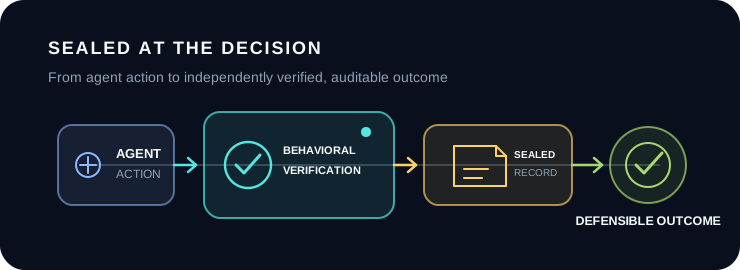
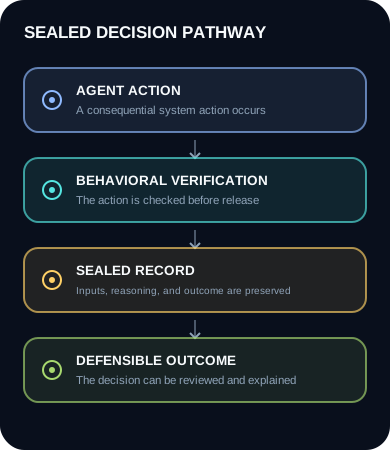
None of that investment is defensible without behavioral verification at the moment of decision. This is where that proof is made public. The governed platform produces a sealed record at the moment of every agent action, evidence that exists before anyone asks for it. Continuous monitoring then confirms whether the system that produced it today is still the system that was verified.
Governance value
Beyond compliance
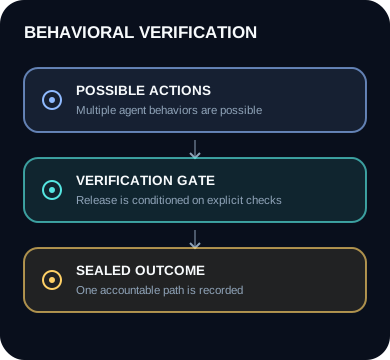
The governance gap
Why isn't existing AI governance enough?
Governance is not just about evaluating a model. It extends through verification, evidence, and organizational accountability.
Traditional AI
- Model
- Output
- User
TTIC
- Model
- Behavioral verification
- Sealed decision
- Evidence record
- Institutional accountability
- User
DISCOVER → CONTRIBUTE → EARN TRUST → BUILD → PROVE
Three Years in the Making
The Trustworthy Technology & Innovation Consortium (TTIC)'s story at AIMed began three years ago in the audience. They were blown away by the quality of the content and the high-caliber clinical AI community AIMed had assembled. They came to learn and left wanting to contribute.
Last year, the operating system. This year, the proof.
The High-Reliability AI Track at AIMed '25 aligned clinical, operational, security, engineering, regulatory, and capital leaders around one infrastructure-first approach to trustworthy, agentic AI, and earned the AI Champion Award. This year, that blueprint is a production-ready, governed system, independently verified, built to protect patients, clinicians, and the balance sheet at once.

Outcomes Rocket with Risk Never Sleeps · Recorded live at AIMed '25
"We had an amazing set of guests. The level of guests we had was just another level."
Ed Gaudet and Saul Marquez
Outcomes Rocket with Risk Never Sleeps

TTIC leadership and speakers at AIMed '25.

AIMed '25 · AI Champion Award, Non-Clinician of the Year · For the team that made this possible.
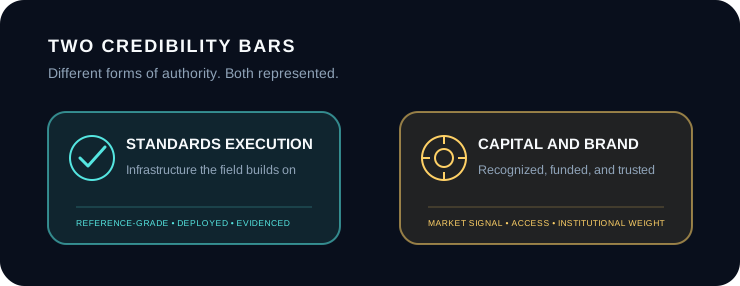
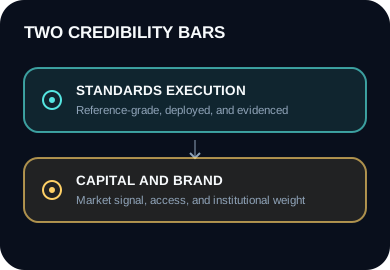
Two credibility bars, both cleared
What makes this roster sponsor-worthy
Every name on this bench clears at least one bar clearly. Neither bar is required of the other, both are represented.
The operating cycle that keeps agent behavior accountable in production
The committed bench
Pro sports leadership, physician executives, and capital
Named leadership across pro sports, clinical practice, and capital.


The funding shift
Why the room is ready for this
Public funding for healthcare and academic medicine is moving. The institutions your attendees lead built their operating models on grants, federal dollars, and endowment returns. Those sources are compressing and the expectations driving capital toward or away from an organization are changing structurally, from institutional compliance to entrepreneurial excellence, from process documentation to verified, measurable performance.
Family offices, venture capital, and multi-generational wealth will allocate to organizations that demonstrate safety, security, operational excellence, and resilience in their AI operations. This track puts attendees in the same room as the people shaping and funding what comes next.
Physician-led AI without governance architecture is a liability event waiting to happen. This track is where the people accountable for that liability learn what governed looks like and hear directly from those shaping and funding the next chapter.
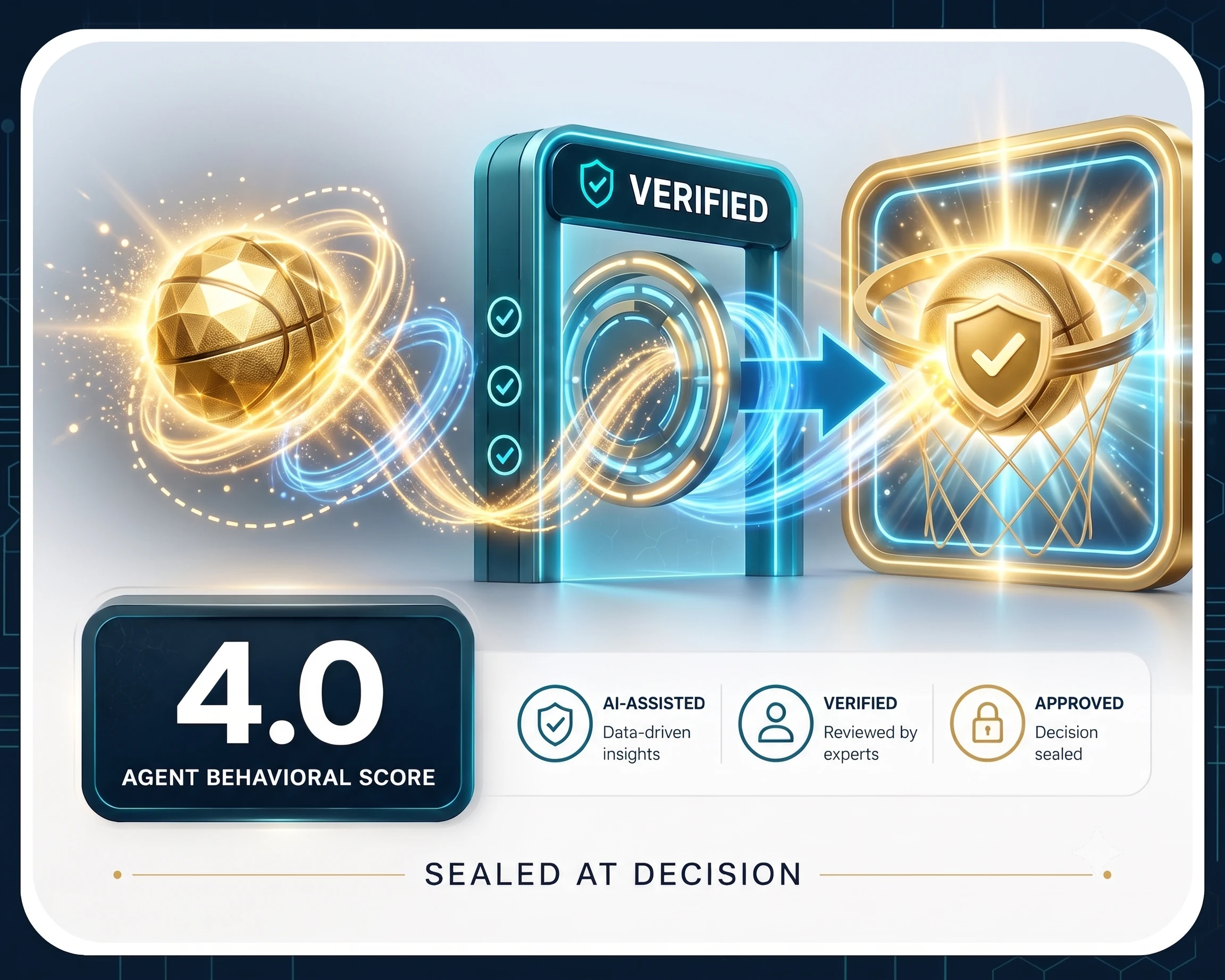
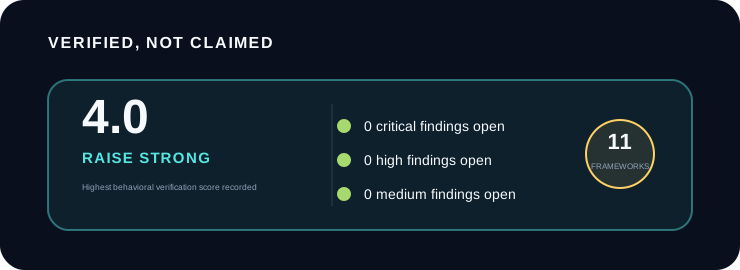
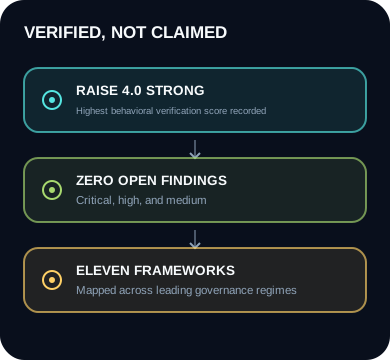
Verified, not claimed
The highest behavioral verification score recorded
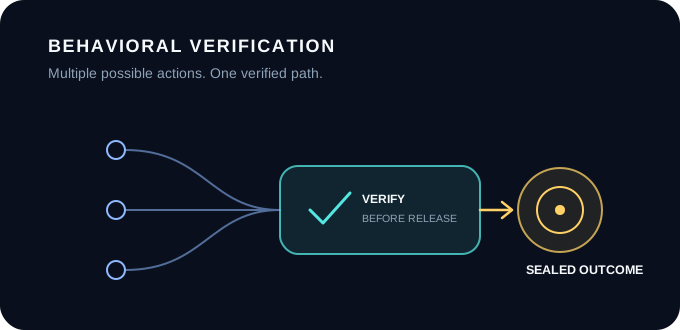
Compliance confirms the paperwork exists. Verification confirms the system behaves the way the paperwork claims, before deployment and after.
Assessed against the Indiana Executive Council on Cybersecurity AI Security System Architecture Layers Designed by Mitch Parker, Co-Founder TTIC · Vice Chair IEEE/UL 2933 · CISO, Indiana University Health
Curated TTIC speakers
A cross-functional leadership spanning every discipline the track requires
All speaker selections are subject to a formal nominating and governance process.

Six books carry her work across Taylor & Francis, Springer, and Artech House.
She edited Mobile Medicine and Advanced Health Technology, and is Series Editor at Taylor & Francis for the series they began.
She contributed to Women Securing the Future with TIPPSS (Springer), Medical Device Cybersecurity for Engineers and Manufacturers (Artech House), and Voices of Innovation AI (Taylor & Francis), and wrote the foreword to A Woman's Guide to Navigating a Successful Career in Healthcare Information Technology.
She is Series Editor of a forthcoming Taylor & Francis volume on AI and cybersecurity for healthcare boards. Its contributing team spans medicine, hospital administration, IT, engineering, law, cybersecurity, and informatics, with dozens of co-authors and editorial reviewers recognized across the disciplines clinical AI governance requires.
She has been quoted in IT and healthcare industry press including Becker's Hospital Review, CIO.com, and This Week in Health IT, now 229Project.
She co-chairs the Trust and Identity Subgroup for IEEE/UL 2933, the data governance architecture standard being adopted for clinical AI governance, and led the TTIC contribution to the authorship of ANSI/HSI 2800:2025, the Hospital AI Operations Governance Standard.
Speaking RecordShe chaired the High-Reliability AI Track at AIMed '25, which earned the AI Champion Award. Her speaking record includes dozens of talks, panels, keynotes, university lectures, and podcasts for professional associations, governments, Ivy League institutions, and leading international universities. She has taught corporate board education for cybersecurity at Santa Clara University.
Current RoleShe is Founder and Chair of Trustworthy Technology & Innovation Consortium (TTIC), the partner to AIMed building the ecosystem behind this track. Ms. Douville is the architect and CEO of Medigram, bringing Darwin, a governed AI decision platform independently verified at the highest recorded behavioral score, into production as the reference implementation of IEEE/UL 2933, for which she co-chairs the Trust and Identity Subgroup and sits on the Maturity Model Committee. She is part of the core team that won the IEEE SA Emerging Technology Award.
Ms. Douville spent a decade at Johnson & Johnson across over a dozen disease areas, winning several awards before being recruited into health IT and AI by physician leaders. She has a STEM degree from Santa Clara University, studied ML and AI through MIT coursework, and has held Series 7 and Series 66 securities licenses.


The convergence of rigorous federal audits, reduced federal and research funding, and firmly shifting private funder preferences is forcing the healthcare industry into a corner. To survive and thrive, healthcare organizations must rapidly adapt to operate much like professional sports teams: highly optimized, interdisciplinary, outcome-driven, and therefore both operationally intense and excellent. This moment can be met with agentic AI, but only in a way that's standards led, by the people that write, execute, fund, and implement them.
In their own words
The leadership who helped build this record
Engineering and best medical practice meet technologically and ethically in the IEEE/UL 2933 TIPPSS process embodied by the Medigram Darwin program.
DR. ART DOUVILLE, MD · CMO, MEDIGRAM · CO-CHAIR CLINICAL INTEGRATION, TTIC
Standards create confidence. Execution creates advantage. The future of AI belongs to organizations that move fast and govern well.
BRIAN YAM · CHAIR, PRO SPORTS WORKSTREAM, TTIC · COO, SOMNOLOGY
Plaintiff attorneys often ask three questions to lock in accountability: what did you know, when did you know it, and what did you do. From what I have seen, a Praxen run answers all three before the questions are even asked.
NOEL GILLESPIE · CHAIR, LAW, TTIC · CHAIR, MEDTECH PRACTICE, BUCHALTER
Continual care requires continual feedback and review to succeed.
MITCH PARKER · CO-FOUNDER, TTIC · VICE CHAIR, IEEE/UL 2933 · CISO, IU HEALTH
Trust is the ultimate measure of success for AI in healthcare. This milestone reflects our commitment to earning it every day.
DR. APURV GUPTA, MD, MPH · CHAIR, CLINICAL EXCELLENCE, TTIC
Behavioral verification changes the diligence conversation for AI agents. You are no longer asking whether the system claims to be safe. You are asking whether it can prove it. When you prove it, that changes the investment calculus.
TOM BONDI · CHAIR, FINANCE, TTIC · MANAGING PARTNER, TCBONDI CPA, INC.
How the track is convened
TTIC convenes this track as a non-commercial standards body. Verified system results are presented by the organizations that built them, in their own voice. This separation is deliberate, and it is part of what makes the evidence credible.
ORGANIZATIONAL STRUCTURE
The ethical firewall
TTIC is a non-commercial standards body. This track at AIMed is a non-commercial activity. Any sponsorship raised goes to AIMed to support the conference. It does not go to TTIC, Medigram, Praxen, or Exabeam.
TTIC maintains a deliberate organizational firewall from the companies whose work it certifies.
Medigram is the commercial reference implementation that executes the standards TTIC governs. Praxen is the open-source behavioral verification instrument TTIC uses as Layer 1 of its certification pathway. Exabeam is the company that publishes Praxen. Both are evaluated by TTIC independently. Neither controls TTIC. TTIC does not sell products. It establishes the governance architecture that clinical AI platforms are held accountable to.
Sherri Douville is CEO, Medigram, and Founder and Chair, TTIC. Steve Wilson is Chair, AI Security, TTIC, and Chief AI Officer, Exabeam.
That separation is what makes the certification credible and what makes this track non-commercial in substance, not just in name.
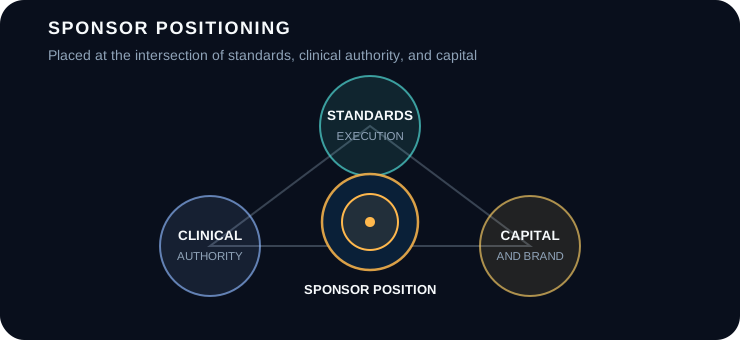
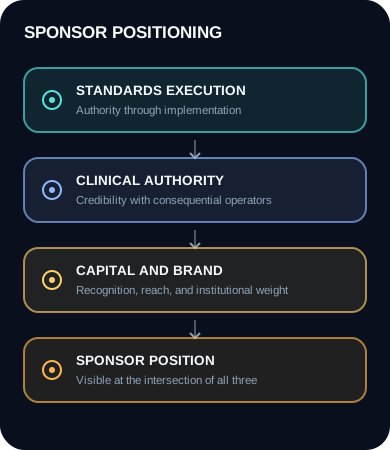
Sponsor value
| Benefit | What it means |
|---|---|
| Speaking opportunity | A speaking slot at qualifying sponsorship levels, governed by the published editorial policy |
| Track co-branding | Co-branding on all track materials |
| Roster placement | Placement alongside the most credentialed governance leadership in clinical AI |
| AIMed26 partner recognition | Recognition across AIMed26 materials: pre-meeting marketing, onsite signage, website, and mobile app |
| Registration and VIP benefits | Delegate registrations and VIP reception access per AIMed's sponsor tiers |
| Content integrity | Every session subject to independent review under the track's editorial policy; sponsorship confers access, never editorial control |
Slots are allocated in the order they are received. When they are filled, allocation closes. There is no waitlist.
Sponsorship inquiries: message Sherri Douville on LinkedIn
- Published by
- Trustworthy Technology & Innovation Consortium (TTIC)
- Author
- By Sherri Douville, Founder & Chair, Trustworthy Technology & Innovation Consortium (TTIC)
- Originally published
- Last updated
- Canonical resource
- https://trustworthytechnologyinnovation.com/aimed26/track/
Cite this resource
Sherri Douville. “High-Reliability Agentic AI Track at AIMed 2026.” Trustworthy Technology & Innovation Consortium (TTIC), 2026. https://trustworthytechnologyinnovation.com/aimed26/track/.