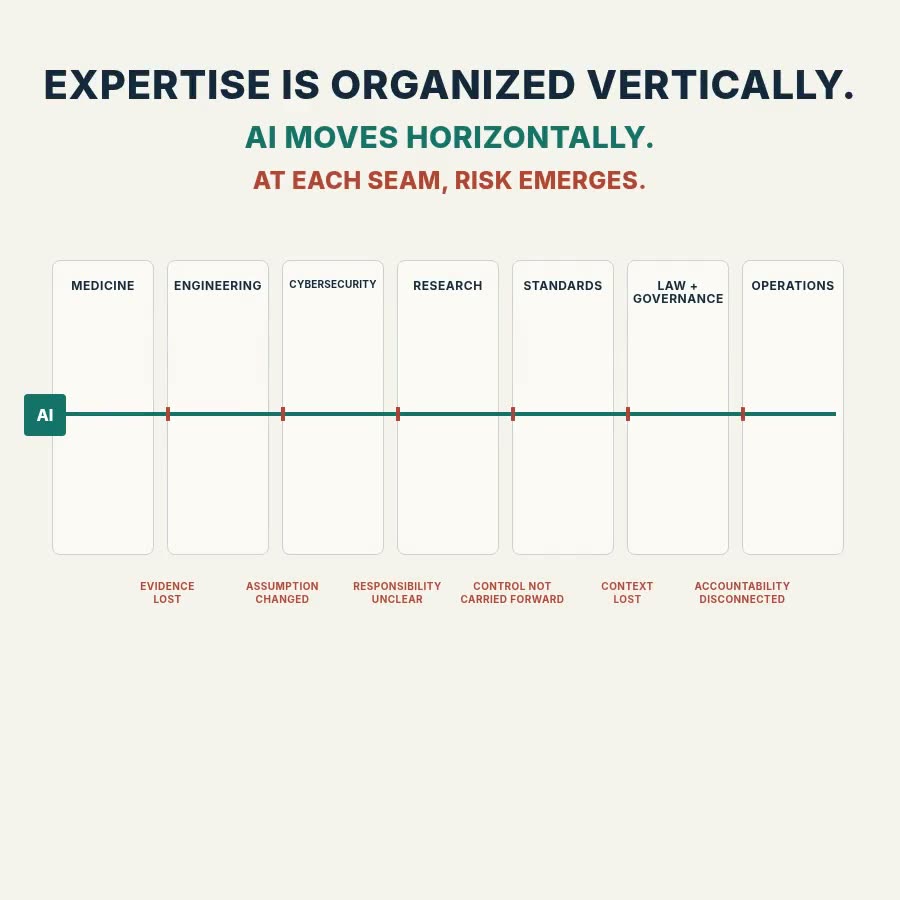
Institutions built extraordinary specialist expertise: medicine, engineering, cybersecurity, research, standards, law, operations. That specialization created capability, and it created fragments. AI moves horizontally through institutions whose expertise and accountability are organized vertically, and at every boundary it crosses, assumptions change, evidence can disappear, and responsibility becomes ambiguous. These are the seams. Every participant can be individually competent while nobody owns the whole outcome. In healthcare that is not an organizational inconvenience, it is a patient-safety failure pathway, because the primary question is no longer “Is this AI safe?” but “Can this institution safely operate AI?” Answering it is a general-management responsibility: the board oversees whether the capability exists, the CEO ensures that it exists, and a designated owner must be accountable for the integrated outcome. Trust does not emerge from a collection of excellent fragments. Someone must own the seams.
Healthcare was fragmented before AI arrived. Anyone who has moved through a hospital as a patient, a clinician, or an executive has felt it: information that does not follow the patient, assumptions that change at every handoff, responsibility that thins as it crosses departments. The fragmentation was survivable because everything moved at human speed, and dedicated people quietly absorbed the gaps.
AI removes that cushion. It moves through those same fragments at machine speed, at scale, touching more functions at once than any technology healthcare has adopted. Fragmentation that used to produce friction now produces dysfunction, and it produces it faster than people can quietly absorb. AI does not create the seams. It accelerates what happens at them.
This letter is about that acceleration: how institutions everywhere, not only in healthcare, arrived at this point, and what kind of leadership it now demands.
For decades, institutions became increasingly specialized.
Medicine developed extraordinary expertise. So did engineering, cybersecurity, research, law, standards, governance, finance, operations, and technology.
That specialization created enormous capability. It also created fragments.
The technology industry learned to manage fragments of trust long ago. It is far less clear when, if ever, it will learn to manage trust as an institutional outcome.
Now accountability is here.
AI does not respect the organizational boundaries we created. It moves horizontally through institutions whose expertise and accountability remain largely organized vertically.
That creates a management problem.
Expertise is necessary. Integration is necessary too.
The Trustworthy Technology & Innovation Consortium (TTIC) was built across disciplines because trustworthy technology cannot be understood adequately from inside any one of them.
A physician should not have to become an engineer. An engineer should not have to become a physician. A cybersecurity leader cannot independently own clinical consequence. A lawyer cannot independently own technical reality. A standards expert cannot independently own implementation.
But the institution remains responsible for what all of them produce together.
The hardest territory is often between disciplines
Organizations are good at drawing boxes. We create functions, departments, committees, professions, reporting structures, standards, controls, and scopes of responsibility.
Reality moves between them.
That is where requirements are interpreted. It is where assumptions change. It is where evidence can disappear. It is where responsibility becomes ambiguous. It is where one excellent discipline can unknowingly transfer risk to another.
These are the seams.
The seam cannot belong to nobody.
General management is what makes someone accountable for the whole when no specialist can reasonably own the whole alone.
That does not mean general managers substitute their judgment for expertise. The opposite is true.
Their responsibility is to ensure that expertise survives contact with other expertise and ultimately becomes institutional performance.
Trust has become business critical
Trust was once easy to place in the category of reputation, culture, or institutional goodwill.
That is no longer sufficient.
Trust now affects customer behavior, workforce commitment, strategic relationships, institutional resilience, and enterprise value. It also determines whether organizations can adopt consequential technologies without creating unmanaged exposure between the disciplines responsible for them.
The business impact is increasingly measurable.
PwC reported in 2025 that adding a trust-and-safety feature made 72% of surveyed consumers more likely to engage and 68% more likely to consider purchasing a new product or service. Deloitte reports that 88% of customers who trust a brand buy from it again, and that highly trusted companies can outperform low-trust companies by up to 4x in market value.
Just as important, PwC found a striking perception gap: 90% of executives believed customers highly trusted their companies, while only 30% of consumers said they did (2024 Trust in US Business Survey).
That gap matters because institutions cannot manage what they merely assume.
Trust cannot be declared by leadership, delegated to one function, or inferred from the existence of policies, standards, experts, and controls.
It has to survive the institution.
AI raises the stakes because it moves horizontally across organizations whose authority, expertise, and accountability remain largely vertical. What begins as a technical decision can become a workforce issue, a clinical consequence, a legal obligation, a financial exposure, or a question for the board.
The fragments are becoming economically connected.
A useful leadership frame is:
Trust value = growth enabled + friction removed + losses avoided + enterprise resilience preserved.
That is why trust is moving from a desirable institutional quality to management infrastructure. It affects whether institutions can move quickly, form durable partnerships, retain confidence, withstand failure, and continue operating when conditions become difficult.
No individual profession owns that full outcome.
The institution does.
Trust must survive the institution
The next generation of trustworthy organizations will not be distinguished simply by how many experts they employ, standards they adopt, committees they establish, or technologies they purchase.
They will be distinguished by whether those components work together when the consequences matter.
Can responsibility cross the seams? Can evidence? Can institutional memory? Can accountability?
Can the organization recognize when a decision that is locally correct creates a system that is globally unsafe?
These are questions of leadership.
AI is making the quality of our institutional seams visible.
As accountability arrives, organizations will increasingly have to demonstrate not merely that every fragment of trust existed somewhere, but that those fragments became a trustworthy whole.
That requires extraordinary specialists. It also requires something increasingly specialized institutions have sometimes undervalued: general management.
Someone must own the seams.
In healthcare, this is a patient-safety question
The argument above is institutional. In healthcare AI it is also clinical. Here is why this is happening, why it creates a patient-safety risk, and who is responsible.
Healthcare and technology both developed deep specialist disciplines. Healthcare is organized into medicine, nursing, quality, compliance, IT, finance, operations, and risk. Technology is organized into product, engineering, cybersecurity, data, AI, infrastructure, privacy, and reliability. Each function has sophisticated methods for managing its own domain. AI moves horizontally across many of them at once, and the resulting management burden is not simply additive. It is combinatorial.
A consequential AI capability must remain coherent across engineering, cybersecurity, data, model behavior, clinical workflow, human judgment, evidence, privacy, legal responsibility, quality, operations, finance, and executive accountability. Every handoff creates a management dependency, and almost no individual specialist is trained or authorized to own all of those dependencies.
Specialist competence does not guarantee institutional competence. An engineer can correctly state that a system performed according to specification. A security leader can correctly state that required controls were implemented. A physician can appropriately exercise clinical judgment. Compliance can correctly state that a required process existed. The institution can still fail if the assumptions, evidence, controls, responsibilities, and escalation paths do not survive the handoffs between them.
The two industries also make opposite assumptions about ownership. Healthcare often assumes the technology provider has sufficiently bounded the technical problem. Technology providers often assume the healthcare institution will determine appropriate workflow, accountability, clinical use, and consequences. AI makes the space between those assumptions operationally consequential.
The dangerous failure does not have to be a visibly defective model. The model may change. A workflow may change. A security control may change. An assumption made during validation may no longer hold. A clinician may believe something is being monitored that is not. Engineering may believe operations owns escalation. Operations may believe the vendor owns it. The vendor may believe the health system owns it. Evidence may not be preserved. Responsibility can migrate during deployment without anyone recognizing that it has moved.
Every participant can be individually competent while nobody owns the whole outcome.
That is a patient-safety failure produced by a general-management failure. AI intensifies it because these systems operate at scale, interact with many systems, influence consequential decisions, and change faster than traditional healthcare technology.
The primary safety question is changing from “Is this AI safe?” to “Can this institution safely operate AI?”
The second question is fundamentally a general-management question.
Whose responsibility is it?
Scroll right to view full table →
| Accountable party | Responsibility |
|---|---|
| Board | Oversight. Determine whether management has established adequate accountability, leadership capability, controls, risk governance, and assurance for consequential AI. |
| CEO | Ultimate executive ownership. Ensure the institution has an operating model capable of safely combining healthcare and technology, and assign an accountable owner with sufficient authority to manage the integrated outcome. |
| Executive leadership team | Own the institutional dependencies across medicine, technology, cybersecurity, quality, legal, finance, and operations. Functional excellence cannot substitute for cross-functional coherence. |
| Designated institutional outcome owner | Own the integrated outcome across functions, including the seams where assumptions, evidence, controls, responsibilities, and escalation paths must survive handoffs. |
| Functional leaders and specialists | Own competent execution and consequence awareness within their domains, including the effects their decisions create for adjacent functions. |
| Technology vendors | Own their products and contractual responsibilities. They cannot own the healthcare institution’s ultimate clinical and institutional accountability. |
No CIO, CISO, CMIO, chief medical officer, legal department, AI team, physician champion, or vendor can individually own the entire problem, because the problem exists between their jurisdictions. An AI governance committee can coordinate expertise, but a committee is not a substitute for an accountable executive with authority over the integrated outcome.
The seam cannot belong to nobody. Deciding who owns the seams is the responsibility of general management.
Healthcare is importing an extraordinarily complicated technological operating environment into an extraordinarily complicated clinical operating environment. The general-management burden this creates is being obscured by specialization. When no one owns the dependencies between specialties, an organizational seam can become a clinical failure pathway. For consequential healthcare AI, assigning ownership of the seams is not merely an organizational-design choice. It is a patient-safety responsibility.
Where we are, and where we are going
The Trustworthy Technology & Innovation Consortium is often admired, and we are thankful for that. But admiration deserves honesty in return.
We are selective. Not out of exclusivity. We are selective because the work is brutally hard by necessity. Making medicine, engineering, cybersecurity, research, standards, law, and operations function as one institution is general management at its most demanding, and pretending otherwise would not be respectful of the people who do it.
Do not mistake this for easy work.
To build an institution like the Trustworthy Technology & Innovation Consortium from scratch to this point, we estimate that it would require the equivalent of three to four exceptional, full-time general managers, representing roughly 10 to 15 cumulative GM-years of leadership, supported by a broad ecosystem of physicians, health-system executives, engineers, cybersecurity leaders, researchers, standards experts, legal and policy experts, and technology operators.
The number is not the point by itself. It demonstrates how much management capacity is required to make sophisticated disciplines function as one institution.
So before we consider doing anything more, we are working on something that sounds simple and is not: helping people understand what this work takes, so they can decide for themselves whether they can help and whether they want to help.
This letter is the deconstruction: how we got here, and why the seams are where trust is won or lost. The letter that follows will set out where the Trustworthy Technology & Innovation Consortium goes from here.
Selected evidence
Sherri Douville
Founder & Chair, Trustworthy Technology & Innovation Consortium